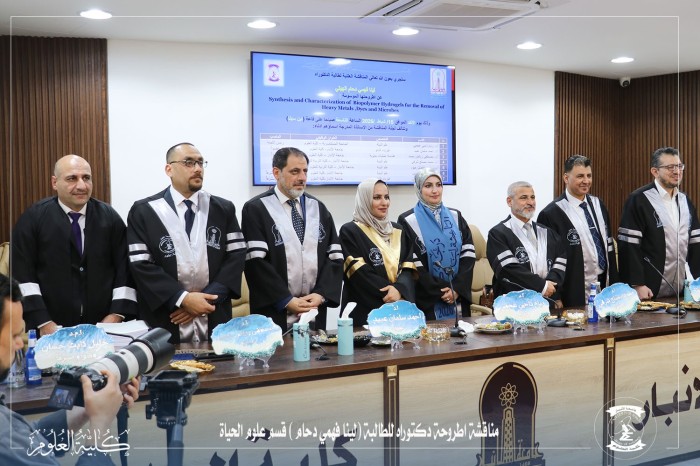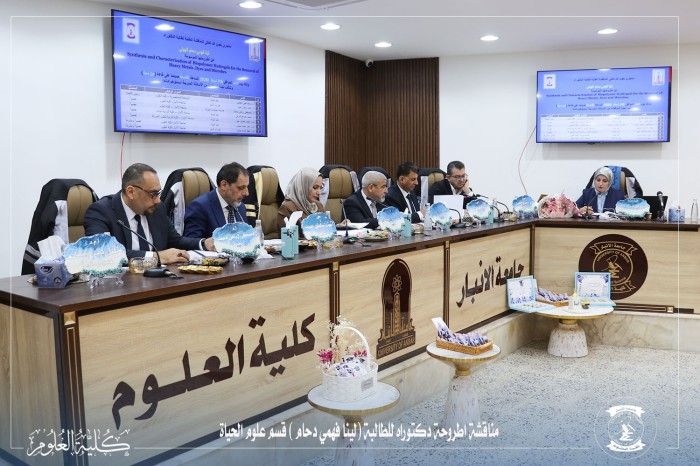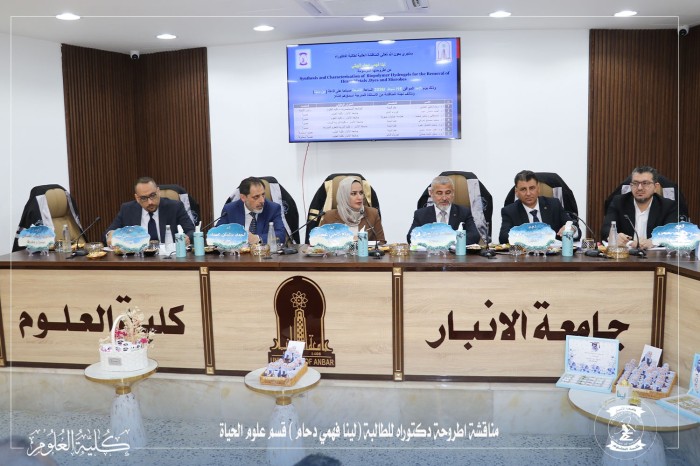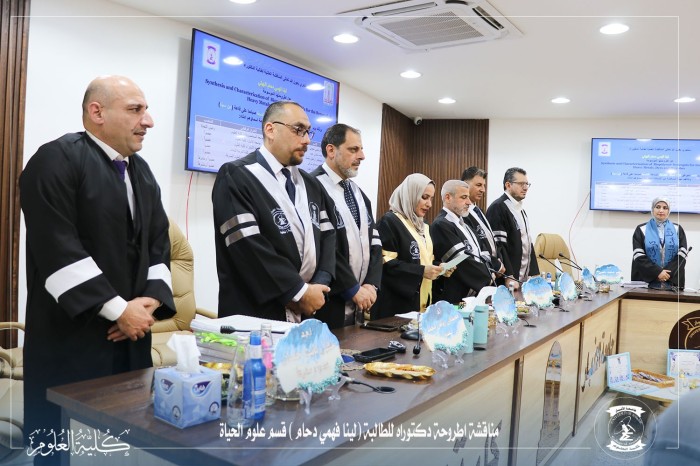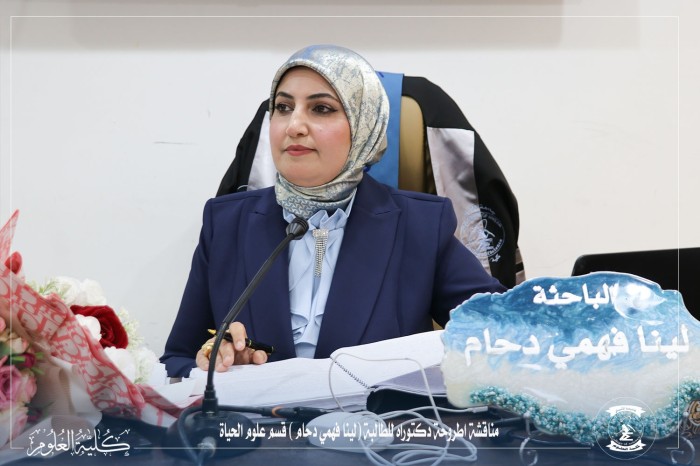
Discussion of the dissertation of doctoral student " Lina Fahmi Daham"
The public discussion took place for the Doctoral student (Lina Fahmi Daham) at Anbar University, College of Science, Department of Biology, on Sunday, 15/2/2026, in the Ibn Sina Hall, for his tagged thesis
" Evaluation of immunohistochemical changes in patiants with celiac disease in Al-Anbar government "
The discussion committee consisted of:
|
Al-Mustansiriya University – College of Science - President |
Prof. Dr. Riyam Naji Ajami |
|
University of Anbar – College of Sciences - member |
Prof. Dr. Ahmed Salman Obaid |
|
University of Anbar – College of Science - member |
Prof. Dr. Mustafa Riyadh Mohammed |
|
University of Anbar – College of Education for Women - member |
Prof. Dr. Mohammed Musleh Sharqi |
|
University of Anbar – College of Education for Pure Sciences - member |
Assist. Prof. Dr. Mohammed Fadhil Aboud |
|
University of Anbar - College of Sciences - Member and Supervisor |
Assist. Prof. Dr. Omar Mohammed Mohsen |
|
University of Anbar - College of Sciences - Member and Supervisor |
Prof. Dr. Khalil Thabit Hassan |
This dissertation focused on the development of low-cost porous hydrogels based on starch and starch–carboxymethyl cellulose (CMC) using a freeze-drying technique, with the aim of employing them as effective adsorbents for wastewater treatment. The results showed that increasing the CMC content improved the porous structure and surface chemistry, leading to enhanced adsorption efficiency.
The starch–CMC hydrogels demonstrated superior performance in removing methylene blue dye, with adsorption kinetics following the pseudo-second-order model and equilibrium behavior best described by the Sips isotherm. The adsorption capacity increased from 12.1 to 25.5 mg/g with increasing CMC content. Furthermore, these hydrogels exhibited improved removal of cadmium ions and other heavy metals, with adsorption characterized as spontaneous and exothermic.
To enhance functional performance, the best-performing hydrogel (P4) was loaded with lemon-derived carbon dots, which exhibited antibacterial activity against Escherichia coli and Staphylococcus aureus, with relatively low MIC and MBC values, confirming their effectiveness as a dual-functional material.
Overall, the findings demonstrated a clear relationship between composition, structure, and performance, confirming that the CMC-rich hydrogel loaded with carbon dots represents a promising and practical platform for wastewater treatment, combining chemical pollutant removal and microbial inhibition within a single, low-cost, and scalable system.